

2026 Ford Ranger vs. Competitors
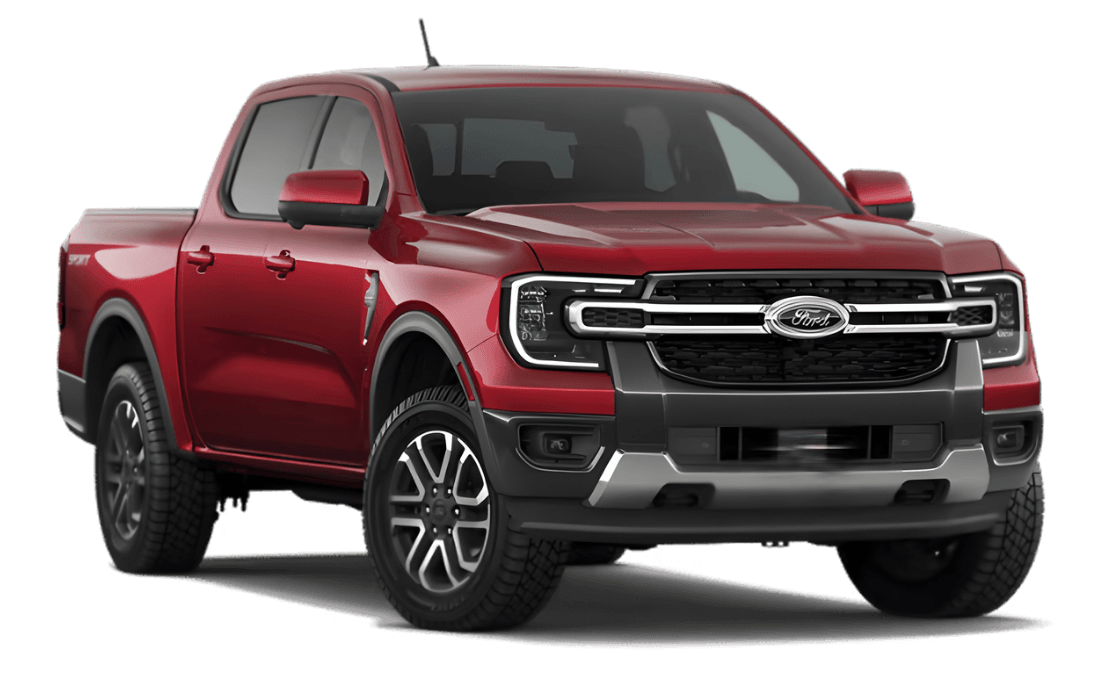
2026 Ford
Ranger vs. Competitors
Midsized pickups sit in a sweet spot. They’re easier to park than full-sized trucks, cheaper to buy, and still capable enough for real work and day-to-day usefulness. The Ranger is a strong contender in this segment, but with competitors like the Chevrolet Colorado, Nissan Frontier, and Toyota Tacoma, it’s not the only game in town. Our goal for this page is to compare the Ranger to those rivals, concentrating on the attributes that buyers care most about. In order to keep things as apples-to-apples as possible, our comparisons involve the least expensive trim with four-wheel drive and a crew cab body for the 2026 model year, unless mentioned otherwise.
Shop Ford Ranger
MSRP and Depreciation
Relatively close sticker prices are a strong sign of a competitive market. The price separation between the starting MSRPs for these trucks is close among these models. The Colorado is the least expensive, with a base price of $35,700, while Nissan and Ford occupy the middle with the Frontier ($36,550) and Ranger ($36,850). The Tacoma comes in the highest, with an MSRP of $37,105.
That said, what you pay upfront is only part of the ownership cost calculation. Depreciation hits almost every vehicle, and midsized trucks are not exempt. According to CarEdge, the Tacoma will lose 22% of its original value over five years, while the Ranger isn’t too far behind with a depreciation rate of 28%. The others don’t fare as well, as the Frontier drops 37% over the same period. Depreciation for the Colorado is the most startling at 48%.
Engines and Real-World Power
Turbocharged four-cylinder engines dominate this class of trucks – except for the Frontier, which sticks with a naturally aspirated 3.8-liter V6 making 310 horsepower and 281 lb.-ft. of torque. The other three models in this comparison tune their four-cylinder engines a little differently. The Ranger’s default 2.3-liter produces 270 horsepower and 310 lb.-ft. of torque, which is stronger than the 228 horsepower and 243 lb.-ft. generated from the Tacoma’s 2.4-liter. As for the Colorado, its 2.7-liter unit makes 310 horsepower and 430 lb.-ft. of torque. The Ranger is the only one of these rivals that gives buyers a choice of powerplant, with an available engine upgrade to a turbocharged 2.7-liter V6 (output: 315 hp and 400 lb.-ft. of torque) for the higher trims.
Real World Capabilities
When it comes to pulling loads, the Colorado (7,700 pounds) and Ranger (7,500 pounds) are closely matched in their towing capacity. The Frontier falls behind with a 6,960-lb. towing capacity. Last place goes to the Tacoma, which is limited to towing 6,400 lb. But payload is where the Ranger takes the lead. It can carry up to 1,763 pounds, ahead of the Colorado’s 1,684. The Tacoma and Frontier fall off from there at 1,500 and 1,330 pounds, respectively.
What Reviewers and Owners Say
A review of these trucks by Edmunds puts the Ranger at 6.9 out of 10, just ahead of the Tacoma’s 6.8 rating. The Colorado drops to 6.4, while the Frontier trails at 5.6. Consumer feedback on Edmunds lines up with an almost identical pattern. Ranger owners give it a 4.4 out of 5 on Edmunds, edging out the Tacoma’s 4.2. The Frontier posts a 3.9, and the Colorado comes in lowest at 3.6.
MotorTrend’s overall rankings for 2026 midsized trucks tell a similar story: The Ford Ranger leads the list, followed by the Chevrolet Colorado. Fifth place is occupied by the Toyota Tacoma, while the Nissan Frontier sits in the seventh spot (last). The other models in the assessment included the GMC Canyon (third), Honda Ridgeline (fourth), and Jeep Gladiator (sixth).
Interior Space
A lot of midsized trucks are used more for commuting than for hauling, so the interior dimensions matter to most buyers. Depending on the measurements, the Ranger is at the head of the class or close to it. Up front, the Ranger has 41.0 inches of headroom. That’s more than the Tacoma (39.7 inches), the Frontier (39.9 inches), and the Colorado (40.3 inches). Legroom follows the same pattern: the Ranger gives you 43.7 inches in the front row, edging out the Tacoma (41.8 inches) and the Frontier (42.3 inches). Second-row seating in midsized trucks can be tight, but here the Ranger does better than most rivals. It has 34.6 inches of rear legroom, compared with 33.7 inches in the Tacoma and 33.2 inches in the Frontier.

May not represent actual vehicle. (Options, colors, trim and body style may vary)
MSRP is the Manufacturer's Suggested Retail Price of the vehicle. Dealer sets final price. Sales tax, title, and registration fees are not included in vehicle prices or manufacturer offers that appear on this site and must be paid by the purchaser. $784 doc & title prep fees apply to all vehicle sales, including manufacturer offers that may appear on this website. MPG ratings are EPA estimates. Actual results may vary for many reasons, including driving conditions and how you drive and maintain your vehicle. See full site disclosure here.